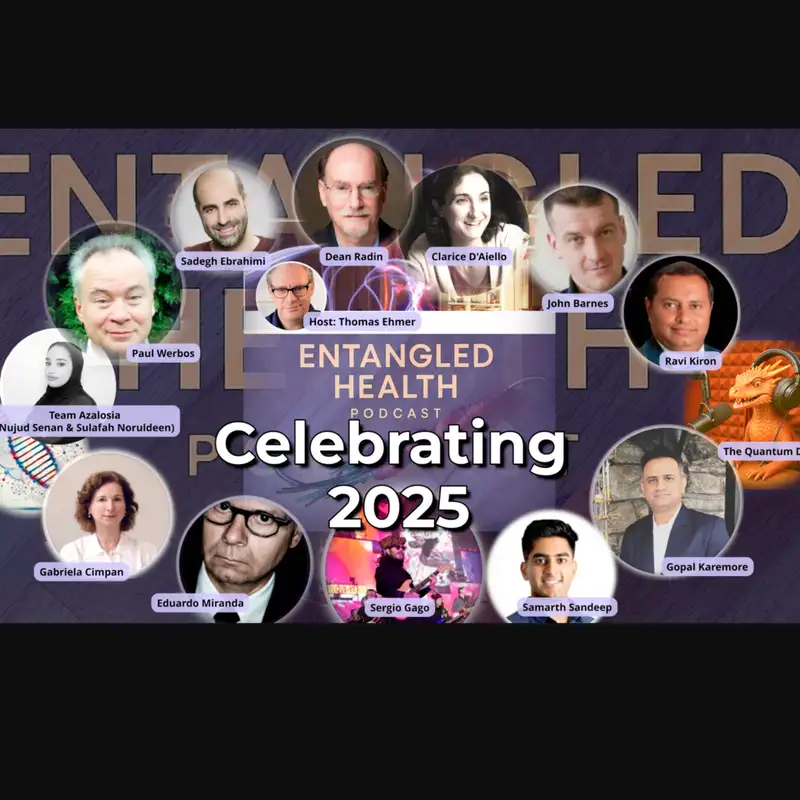
Entangled Health 2025 Celebration: All Guest and their Voices Entangled on Quantum, AI and Future Health
Welcome to the Entangled Health
Celebration series.
You've just heard 13 voices
talking at once.
It sounds like case, but it
isn't.
Its entanglement.
Different minds, different
generations, different fields,
and all crossing wires around
the future of health.
Today we're trying something
different, an experiment within
the experiment.
Instead of our usual format,
where you meet one guest and a
deep dive into their work, I've
woven together voices from the
earlier conversations around a
single thread, a story that
keeps emerging across different
experts, different disciplines,
and different perspectives.
And the idea is simple but
radical.
What if the best answers to the
biggest questions don't come
from one expert in one field,
but from the entanglement
itself, from the connections
between the fields, between
minds, between different ways of
seeing the same problem?
Before we start, the usual
disclaimer, this is not a
medical advice, and what you
hear are personal takes,
interpretations, working
hypothesis.
These are conversations between
friends, exploring frontier
where science is still being
written.
Nothing you hear here represents
any official position from any
company or organization, and we
are here in a personal capacity,
speaking our own truth.
Now here's something important.
The goal of this episode is not
to give you answers.
It's to show you how answers
emerge when we stop working
working in silos, when a quantum
physicist talks to a biologist,
when consciousness researcher
sits with someone measuring tiny
magnetic fields, and when people
from completely different worlds
realize they're actually
describing the same phenomenon
in different languages.
So let's go.
So this is the entire pharma
drug discovery value chain.
So you start with an idea,
you've got a disease that needs
some kind of therapy or treat.
So you try to understand the
molecular mechanisms of what is
causing that disease.
This is.
Ravi Kirun describing the
classical way we develop drugs.
And then you identify a chemical
moiety, whether it's a small
molecule or a peptide or a
protein that can change the
functionality of that disease
paradigm such that you get an
outcome.
And the outcome would be
reduction of disease or curing
of the disease so that the
quality of life for the patient
is improved.
Today's episode asked the
question that might sound crazy
to a doctor from 20 years ago.
Maybe the body is not just only
it's biochemistry.
Maybe the problems we are trying
to solve, complex disease, drug
discovery timelines, the mind,
body connections have become too
entangled for classical
approaches to handle.
But the question that we need to
ask now, do we really solve the
basic problem of healthcare and
life science?
Not really because we've just
scratched the surface, right?
Because we still need to
understand what is antimicrobial
resistance, right?
Or what is, what is a cancer,
what is gene therapy, you know,
stem cell research.
These are all unsolved questions
for us, right?
This was Gopal Karamwa from IBM.
Let's start with the wall.
Modern medicine is
sophisticated.
We have genomics, proteomics,
brain imaging, wearables, and
yet we are stuck.
Let's listen maybe to Gabriela
from Continuum.
What she thinks.
So as an individual, you want to
know what common causes make
disease develop?
What from our unique makeup
contributes?
What from our external
environment contributes?
What can help heal with or
without external helping agents?
Let's look again at the
classical development workflow.
It's not from that.
And then you develop a few
molecule leads, molecules that
you test in a hypothesis in a in
vitro setting.
And if the results there are
relevant, then you take it to an
in vivo setting with animals.
So with rats and mice and dogs
and non human primates as as
required.
But there's always the yin and
the Yang saying you can cure a
cancer in a mouse, but you
cannot cure cancer in a human
because human methodology and
and human disease is probably
much different than even
humanized mice which have that
cancer.
So we do not want to treat
animals, but we want to heal
humans, and those are really
super complex.
But being said that, at least
you can use that kind of
methodology to determine whether
this molecule you're trying to
develop is safe and effective.
It doesn't have any major bad
side effects and things like
that.
So we try to speed up things
with computation and artificial
intelligence.
And this is a hugely difficult
problem to solve.
Mathematically difficult.
There are so many parameters to
take into consideration.
It's a huge number which most of
the time we can quantify and
analyse individuals.
So we finally have our compound,
but it is still a very long way.
So then you take it to a
preclinical model and then to a
clinical model where you do a
phase one where you're testing
the hypothesis in normal healthy
volunteers who are where you're
just seeing whether this
molecule has an effect or not.
For that matter, every molecule
has has an effect good or bad.
In fact, to the extent that if
you drink gallons and gallons of
water, you could die.
So, but having said that, that
kind of testing is important.
And because it's a regulated
industry, then you go to a Phase
2 with patient population and
then to a large phase three.
So this whole process can take
anywhere between 8 to 12 years,
go from idea to the market.
There's numbers all over the
place, but let's say an average
of it takes $2 billion to take
an idea from the beginning to
the market, and this is taking
in all those molecules that have
died in the process.
But then, if you take into
consideration the
interdependency influenced by
different factors, genetics,
environment, the choices we
make, you might say that we are
entangled.
So that word untangled is not
poetry, it's mathematics.
And the single patient's health
depends, apparently, on
thousands of variables that all
influences each other.
Classical computers just can't
hold that in their head, and
neither can human doctors.
So what happens?
We simplify, we ignore
interactions, and we treat
diseases as isolated problems
instead of system problems.
And we fail.
So what about other technologies
I.
Landed up at Merck AG as Silicon
Valley Innovation Hub and this
was a real opportunity for me to
really identify novel paradigm
game changing technologies and
bring them into the company and
see how they could really modify
and speed up.
Because a mentor at Pfizer told
me once that innovation is
seeing patterns others miss.
And I think that was the key
that I had the unique
opportunity in Silicon Valley to
identify novel game changing
opportunities.
And my strong belief is that we
need a tool such as quantum
computing to really go deep into
the understanding of the
biologic chemistry and physics.
And when you think about the
convergence of what is going on
in the world today, quantum
obviously is is a big topic, AI
and agents and so on, it's
another one.
But the new materials and
robotics and nano robotics and
other things that are completely
outside of my area of expertise,
but potentially much more into
the health industry.
Oh wow, what a time to be alive.
This is Sergio Gargo, the CTO
from Cloudera, and he's just
fascinated by the way technology
is speeding up.
Yeah, put all that together, a a
lot of huge disrupting
technologies and and scientific
research at all, each of those
by themselves could create an
industrial revolution.
And now you put these 1012
technologies and things that are
happening exponentially faster
every every six months.
There's there's a woe factor
happening in the world.
It's difficult even to keep up
right?
It is indeed a fast evolving
field.
Yeah.
So fortunately I like reading
and I like talking to people, so
I read a lot every day.
I obviously read about advancing
quantum technologies and keep up
to date with the news, but I
also read as much as I can about
human biology and psychology,
with a focus on what shapes us
today.
What we have been seeing in the
last 10-15 years in all areas of
science and industry, working
together, it's both exciting and
mesmerizing.
And I like to think how how my
kids, how our kids are going to
live in the world in the future,
what type of jobs they will have
and effectively how will we live
our lives.
I cannot even start thinking
about that.
So maybe it is entangled health,
but also entangled.
Lifestyle.
But I also read as much as I can
about human biology and
psychology with a focus on what
shapes us today, which probably
suits the term entangled health,
how these changes impact our
bodies, what are the
consequences.
And I discovered maybe just me
who recently discovered, maybe
this has been happening for a
long time, but I'm part of a
growing group of people who want
to understand how we can stay
healthy over the years, age
healthily and happily, and build
a better society.
Or or at least try to do.
So Cabrilla just said something
crucial.
We are part of a growing group
trying to understand health
differently.
But here's the real question.
How can we build that better
society if we don't even
understand ourselves?
Let's hear what Eduardo May
underexplored.
Eduardo is a composer and
professor in Computer Music, and
he has not only composed the
opera that you hear in the
background, but also has
developed technology that lets
us see our own newer patterns,
our own brain staves.
And once you can see something,
you can change it.
And I'd begun to use machine
learning to be able to
distinguish between these
different kinds of electrical
brain waves that, you know, try
to classify them according to
specific cognitive tasks that
people were doing.
Then I realized that it is not
as easy as as one may think it
is.
You know, that we are very
different from each other,
Thomas.
Our, our brains is, is like our
fingerprint, right?
We are very different and trying
to find common ground between
people's brain is, is finished.
It is really difficult.
So then I, I kind of begun to
look into other, other
techniques.
For example, what if I could
stimulate, you know, give
stimulate to to people to, to
stimulate the brain somehow and
then use that for for making
people to train themselves to
produce a specific brain waves.
Eduardo enabled paralyzed
musicians to perform together.
You hear them in the background.
How?
How do you translate intention
into action when the body won't
respond?
That's the question at the heart
of what he discovered.
And if you want to understand
the actual mechanics, the
details that matter, listen to
our full conversation with
Eduardo.
But what we created here was a
way where for people were able
to communicate between
themselves and that is.
Yeah, that's the social
component exactly.
They, they were playing with
each other even though they were
not able to talk, they are not
able to, to make gestures and so
on.
But they were paralyzed from the
neck down.
They, they only had very little
eye movement or mouth movement,
right?
And but they were talking, they
were communicating emotions to
themselves.
When we ignore the mind, we miss
half the healing power.
So we have three walls,
complexity which we cannot
compute, timelines we cannot
meet, and the human dimension
which we cannot measure.
How do we breakthrough these
three walls?
Let's meet the quantum
sledgehammer.
Quantum computing can finally
hold complexity that classical
computers never could.
And there's one fundamental
problem, aging, that sits at the
root of nearly every major
disease.
It's systems entangled with each
other.
And that's where, as a Lucia, a
winning team of Saudi Arabia
women, started.
Let's see a reach from the team.
It's because we as people, as
humanity, have.
Came.
To realize that the root to
most.
Of our health problems.
Actually is ageing.
For example many diseases such
such as cancer are more
prominent or show huge
increasing as we age.
So for example they say do more
scanning.
After 40.
And that's because something
happens.
Something that we are.
Interested in discovering what
exactly this?
Something that's.
Actually our question what
exactly is happening?
To our bodies after we passed
for.
Example 70 years suddenly all of
these diseases start to.
Come to us.
Why is that so this question, we
as a team think that it can be
answered not only using
traditional ways.
Because they take forever.
But by using the great strong
power of machine learning and
quantum so.
Najood can talk more about how
Quantum can.
Be utilized for complex data and
how it can help speed up the
process of this analysis, but in
general it's.
Basically that we have.
So much data that might have
patterns that.
We.
As humans, it's very difficult
for us to.
Analyse this data and.
Come up with these patterns and
understand them and makes
something out of them.
So we start with quantum
computing.
The work from Azadosia is still
early research, so let's hear of
a published result from IBM and
listen again to Gopal.
And we have actually shown using
our recent paper that the
publication that we had with
Rican, it's a Japanese research
organization that the method
like sample based quantum
diagonalization, how these
methods in conjunction with
classical computer supercomputer
can help solve the problem in
two hours which you which would
otherwise take years to really
solve only on the quantum
computer, right?
So I think this is also very
fascinating from the drug
discovery side and the molecular
discovery.
Two hours instead of years.
That's not just faster, that's
another category of capability.
There seems to be evidence that
in some areas in healthcare and
life sciences, quantum computing
can help.
The point is, it's not replacing
classical computing, but it's
augmenting it.
Here's Gopal again.
And totally.
So for that reason, I mean, we
conducted A webinar which is
available and just for the
listeners who really want to
know deep dive into what is the
possibility of each and every
functional areas of drug
discovery and development.
Because I strongly believe when
you say healthcare and life
science, life science is related
to understanding disease
mechanism where the Healthcare
is related to the patient data.
So the the bridge between this
healthcare and life science is a
pharma company, right?
Because this is where exactly
the translational science
happened.
Translation medicine happens
right from that's what that's
what they call bench to bed
site, right?
You may be having a really nice
basic research and all, but
unless you put it into the
practice, like put it into the
FDA regulation, become that as a
drug available to the patient,
it's not helpful, right?
It's a second quantum
sledgehammer.
If you cannot measure it, you
cannot optimize it.
Quantum sensing lets us measure
things that classical sensors
have no way to detect.
Let's see a Clarista Yellow, a
pioneer in the field of quantum
biology.
In my PHDI worked with a
technological quantum sensors.
The idea is that you can
mathematically prove that if you
use quantum objects like an
electron as a sensor, your
measurement is improved.
In other words, the sensor
quantumness enhances the
measurement.
I work with a very famous
technological quantum sensor
which is a spin in diamond in
the material diamond and a.
Couple cool.
Things about the sensor is that
one, it's a very good sensor of
magnetic fields, two, it works
at room temperature, it's
quantumness survives for long
enough at room temperature to be
useful.
And three, the fundamental
quantum property that people
that that the sensor uses to
sense in a quantum enhanced way
magnetic fields is superposition
spin, electron spin
superpositions.
Healthcare as a total as a whole
is changing nowadays and we are
seeing a lot of new things
popping up as we can detect many
things that we were previously
not capable, calculate things
that we were not capable, do
cool stuff, yeah.
So quantum biology is real
shoulders.
Quantum effects are already
happening in living cells.
Magnetic sensing at room
temperature.
But knowing it exists and being
able to measure it are two
different things.
Let's see his ADEX journey.
His expertise in quantum sensing
is the bridge between theory and
detection, turning what Clarice
described into data we can
actually use.
And then I went to Helmholtz
Institute GSI in Darmstadt.
And then I did the ion traffic
experiment, basically localizing
highly charged ions and doing
fundamental experiments and
measuring with the with the
highest precision possible.
The number that you throw around
in this kind of experiments on
mind boggling.
So in this time, because you
know, GSI has it's famous and it
has a claim of fame in a
specific type of therapy, which
is proton therapy for cancer.
With accelerators and then you
just use the the the particles
itself to destroy the cancer.
Yes, basically where it was
invented.
Yeah.
And looking at them, that was
where it got me excited about
the applications of new deep
tech and high tech stuff for
healthcare.
But nowadays, as our
technologies advance, especially
in sensing, I have the idea that
sensing opens new doors for us.
As we advance in our technology,
as we advance in our
manufacturing, we have started
detecting signals that
previously was not possible.
So we have two sledgehammer
quantum computing that processes
the unprocessable and quantum
sensing that measures the
unmeasurable.
But there is still a gap if you
if you have perfect data and
perfect computation.
If different domains can't talk
to each other, nothing happens.
The silos are as much a problem
as the science.
I work in an interdisciplinary
field called quantum biology.
And one of the big problems that
we have is that we found out
that people from different
fields don't talk to each other,
right?
So I think that your, your
solution to this problem is
laudable and I think that we
should have more of, of this
type of dialogue where people
from bio talks to people from AI
talks to people from physics
talks to people from chemistry,
right.
And I think because, because I
think that the the nicest
problems, the ones which are not
incremental are probably
interdisciplinary and
interdisciplinarity is a
buzzword.
Everyone likes to say that they
do interdisciplinary science.
People like to say that they
fund interdisciplinary science.
We'll.
Talk about this.
Later I get from right and it's
it's like a big lie.
I mean is a big.
Lie.
While students are still
separated in departments, while
departments are still
departments, while in funding
bodies, there are still funding
bodies for chemistry, bio and
stuff.
It's not going to happen.
I mean it's, it's, it's
intrinsic to our system.
We need a a re hauling and
that's part of what of what
we're trying to do in my current
organization.
But breaking those silos isn't
just about technology.
It's about people.
It's about building ecosystems
where different kinds of
knowledge can actually connect.
John Barnes has been asking that
question since 2014.
Yes, I think first thing I
thought of was around.
The health of quantum and
ecosystem.
And.
I think.
It was.
It was.
More the almost like that the
mental health of.
Quantum so you.
Know where are we going, what we
wanted to achieve?
How do we?
Get there, who's this for and
those that kind of existential
aspects of it.
And that's where the third part
comes in.
Maybe AI and machine learning
are in translation layer.
Creativity is, I think a very
important human characteristic
and trying to get machines to,
to simulate creativity, I think
it's a bit of a waste of time.
But I think to get machines to
help us to be creative, that is
the key.
Because at the end of the day,
you know, we we need to to think
about humans, to think about
ourselves and not about
terminating ourselves, but
actually, you know, making
ourselves better, better people.
And I think that technology are
instruments for that.
Technology as an amplifier, not
a replacement.
That's the philosophy that
actually works.
So now we have the full stack
quantum computing for modeling,
quantum sensing for measurement,
AI for translation and
amplification, and community
builders asking who this is for.
That's the sledgehammer, and
it's starting to work.
Somat Sandeep is proof of that.
So that's when I decided later
that year that, oh, I'm going to
start my own company that's
going to be focused on
biological modeling.
I think the main thing that I
was interested in was I wanted
to see if there are improvements
that can be made in protein
docking to start with.
So I, I had heard about a
professor at UC Davis who was
looking at how yeast proteins or
proteins, specifically
extracellular proteins in yeast
could bind to nutraceuticals.
So things like curcumin or
whatnot, we looked at protein
pruning as a way to identify
binding sites before or really
blocking atoms.
Atoms are blocking interesting
binding sites before doing
docking and then did that.
That was OK.
But really what what took off
the company and, and made it a
company rather just a fun set of
projects was we wrote about
protein binding with regards to
hydroxychloroquine, azithromycin
and how so this is the beginning
of the COVID pandemic and it was
clear that these drugs don't
really do anything.
So we basically sure it does not
do anything.
But that paper got cited a lot
because it was something that
people were needing at the time.
So that's that's then how we got
our first client at UC Davis
Medical Center and at for with
my company if and only if
technologies.
What happens when the wall comes
down?
Once we can measure everything,
compute everything, and see
everything, what do we find?
The answer might surprise you.
We don't find a machine, we find
something much stranger.
But what did you learn from
that?
You learned that, you know, drug
discovery and development can
happen with not just traditional
ways of identifying a disease
and develop a therapeutic for
it, but you can also learn from
traditional Chinese medicine.
You have Ayurveda in India, and
a lot of it goes back to another
major point in drug discovery
and development that we have not
touched upon, and that's called
the placebo effect.
And so if you believe in
something, even giving somebody
water and they have the belief
that the water that you give
them is going to cure them, it's
stranger than life fiction, but
they have been cured.
People are so there is a whole
body response to something like
this that does work, but of
course you cannot scale it.
You cannot promise somebody and
charge them, make some money for
the water that you give them.
So that's interesting,
consciousness and at the center
and the power of mind.
Let's see what we can do with
that one.
I have learned to be careful.
In this space there is a lion
and crackpots stand on the other
side.
I have to put a no fly zone with
a large buffer zone around that
space.
OK, this was the quantum dragon.
Let's be careful here.
Then if you're trying to bring
some of these things into the
normal pathway, then then you
have to have really pragmatic
trials with pre registered
endpoints and and you have to
look at how the mindfulness and
everything of this digital, you
know, typing can actually
benefit I'm.
Way more confused than he is.
You mentioned Aura and I say
that as you said, there are
publications that speak about
detecting bio photons and they
were.
We were not able to measure them
because the signal is so faint.
It's basically to most of our
imaging systems undetectable,
but see them and as we advance.
Our.
Technologies in sensing, I'm
sure that they will be turning
out into having different
spectrums, colors, I don't know,
different intensities as you
said.
And our ancient wisdom had this
included in them.
So basically we have to be very
careful not to believe anything,
but we have to change our
mindset to a state of open
mindedness to explore the things
that we have basically
disregarded up to now.
To truly navigate that no fly
zone, to tell the difference
between legitimate frontiers and
the crackpots, you need someone
who spent decades in the exact
places where science gets
uncomfortable.
Which is exactly where Dean
Radin has chosen to work.
So I happen to pay attention to
research in anomalies because
truth is revealed by anomalies
and not by conformance.
By conformity, it's anomalies
rather than conformity.
So it's attracted to things that
didn't quite fit, and one of
those things was
parapsychological claims.
So where is the boundary between
breakthrough and bullshit?
Dean Radin has been studying
that intersection for 40 years.
The Dragon's nofly zone protects
the messy middle, and Dean Radin
is the cartographer of that
territory.
And so just when I was preparing
to leave with my doctorate, I
noticed that there was a job
opening at Princeton University
for a group there that was doing
research on these kinds of
phenomena, mind matter,
interaction phenomena.
In fact.
What the hell?
If you've spoken to Dean Raiden,
I can tell you a human part of
the story.
I suspect your audience is more
more human than some of the
scientists I deal with.
This is Paul Werbus, one of The
Pioneers of artificial neural
networks.
When I was young, I really
fiercely believed that the
concept of the human soul was
total nonsense, and psychic
phenomena was even more total
nonsense.
He's not a mystical thinker, and
he's not alone in this belief.
So I applied and I basically
would have been given the job I
would like.
I was qualified for it,
qualified for it, but I was told
and recommended that you don't
want to do this as your first
job.
So don't start your doctoral
career with a controversial
topic because that will that
will taint you for the rest of
your life.
So I paid attention to that.
So I went to Bell Labs instead
and did conventional work.
But I still remember that this
was a very attractive topic
because it was conventional
science, or at least the
epistemology of conventional
science being applied to things
that were considered way out on
the fringe.
If we live in a universe which
is 3 dimensions of space and one
of time, if that's what the real
universe is just like what
Einstein thought, it seemed as
if that could not be reconciled
with certain experiments.
And so at Bell Labs, I started
doing those experiments.
I, I took advantage of business
travel to visit laboratories
around the United States to talk
to people and see what they were
actually doing.
The few people who were actually
scientists doing this kind of
work.
And I became more and more
intrigued.
So I figured out a way to
actually incorporate this a
little bit into some of my Bell
Labs work by looking at the mind
machine interaction.
But at the end of the day, yes,
the experiments disagreed with
common sense ideas of time.
If you replace these ideas of
time with time symmetric models
of the macroscopic objects you
use in the experiment, the
paradox will disappear.
I've worked out the mathematics
to show it's not impossible.
You can be a hardcore realist
and still believe in psychic
phenomena, which is the other
side of life.
After 1967, I explored and
explored, and I think there's no
doubt that the psychic phenomena
are very real, though we do have
what we call souls, that there
is a kind of spiritual
connection between US, and it is
consistent with mathematical
science.
And I learned that what has been
irrationalized at the moment
used to be our ancient wisdom,
as you said.
I don't have a question as such,
but all all I would say is the
feature of Healthcare is
entangled.
It's completely entangled with
science and technology and
humanity woven together for me.
The personal convincing point
was when I was doing an
experiments at the GSI.
Yeah, I have recognized there
are things beyond our current
framework of material science
that we have.
Because when you touch the edge
of the science and then try to
push it a little bit forward,
there's a point that you leave
the one boundaries of the known
science.
See stuff that you're sure that
the level of our understanding
of our current framework of
science lacks a lot and leaves a
lot to be.
So I was convinced to look for
more.
Yeah, but I pay attention to
quantum sensing mostly break
computer interfaces.
I would like to see the
intersection of quantum
computers.
Using quantum information.
For quantum sensors over.
I recognize OK in our material
framework, whatever we cannot
prove or detect or measure, we
immediately put them in a non
scientific category.
But nowadays, as our
technologies advance, especially
in sensing, because as I've
said, I have the idea that
sensing opens new doors for us
as we advance in our technology,
as we advance in our
computational power, as we
advance in our manufacturing, we
have started detecting signals
that previously was not
possible.
And tangle health.
It's an intriguing name, isn't
it?
It brings to mind overlapping
and intercorrelated fields, and
also what is entangled.
So I looked it up.
According to the Oxford
Dictionary, it means cause to
become twisted together with or
cough in.
So I can imagine overlapping an
interdependent scientific
fields.
A nice colored graph if you may,
but then if you if you ask what
is entangled, we can also ask
what is health?
So I'll look this up as well.
As defined by the World Health
Organization I quote is a state
of complete physical, mental,
and social well-being and not
merely the absence of disease or
infirmity.
This definition emphasis that
health is more than just the
absence of illness.
It encompasses a positive state
of being across multiple
dimension.
Gabriela is describing the real
frontier now, not building the
technology, but building the
system that delivers it.
That system has to bridge
quantum physics and patients.
It has to bridge venture capital
and clinical evidence.
It has to bridge individual
healing and collective health.
Retangled health isn't a
metaphor anymore, it's a
description of the actual work
that has to happen.
It was always a hacking mindset
with I guess the driving force
was what if let's just do it
makes it happen and being
always.
I think two things that drove my
minds and one is try to be the
stupidest person in the room.
Many people tries to be this
marked as one, right?
I think it should be the other
way around.
You have to surround by people
that are smarter and more
intelligent than you.
And then #2 is be brave.
And sometimes you're just
outside of your comfort zone
doing something that you're
definitely not prepared to.
But Halsey, yeah, let's go and
do it.
And things will happen.
Today we tried something
different, an experiment within
the experiment.
Instead of meeting one guest and
diving in deep into their work,
you heard Logan voices from
earlier conversations around a
single thread that keeps
emerging across disciplines.
The idea was simple but radical.
Maybe the best answers to the
biggest questions don't come
from one expert, but from the
entanglement itself, from
connections between fields,
minds, and ways of seeing the
same problem.
And this was only a snapshot.
We haven't even heard from all
13 guests yet.
But as I do my digesting work
here, I just got another idea
why not inviting you to submit
your director's cut.
So feel free to download the
hours of material and just
prepare something that is
fitting to you.
And I'll be really keen to
listen to your perspective.
So what's coming out, what you
make out of the raw material,
what ideas you generate that
will be cool?
Yeah.
Let's see.
Yeah.
Dear friends, we are now
entangled.
Thanks for listening and for
being part of this experiment at
the intersection of quantum tech
and health.
If today's conversation sparked
an idea, a critique, or
triggered the question, please
share it.
And maybe your question is
selected in a future episode out
of the Growing pool.
And you know the game.
If you like it, please
subscribe, leave a rating, and
then tackle further by passing
this episode to someone you
think should join the gang.
Until next time, stay kind, stay
curious, and keep exploring the
unseen with untangled health.
Creators and Guests