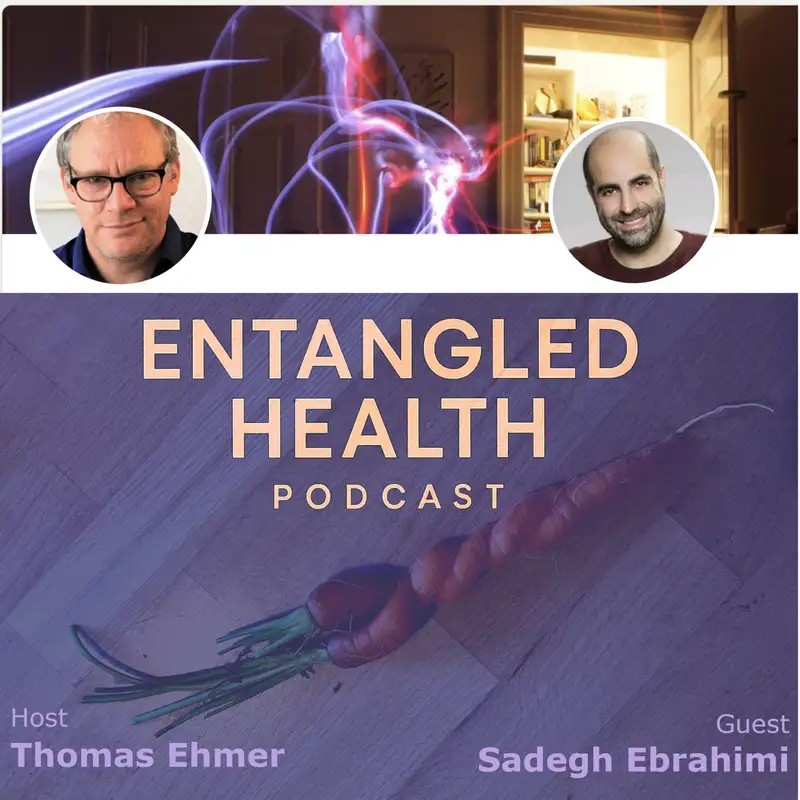
Sadegh Ebrahimi: Sensing the Unseen (The Birth-Episode of Entangled Health Podcast)
Physicist Sadegh Ebrahimi explains why quantum sensing, not quantum computing, is healthcare's true silent revolution — and how it could let us sense consciousness, biofields, and even communicate with nature itself.
In this founding episode of Entangled Health, Sadegh Ebrahimi shares his journey from Iran to pioneering atomic-level diagnostics at the GSI Helmholtz Centre, revealing how quantum sensors detect biomarkers with unprecedented precision for non-invasive early disease detection. The conversation moves from hard physics into biofield science, consciousness research, and the philosophical humility required to explore what current science can't yet explain.
In this founding episode of Entangled Health, Sadegh Ebrahimi shares his journey from Iran to pioneering atomic-level diagnostics at the GSI Helmholtz Centre, revealing how quantum sensors detect biomarkers with unprecedented precision for non-invasive early disease detection. The conversation moves from hard physics into biofield science, consciousness research, and the philosophical humility required to explore what current science can't yet explain.
TRANSCRIPT: https://share.transistor.fm/s/61423ae6/transcript.txt
---
FAQ: Sensing the Unseen — with Sadegh Ebrahimi
Who is Sadegh Ebrahimi?
Sadegh Ebrahimi is a physicist and quantum sensing pioneer who studied physics in Iran before moving to Germany, where he worked on ion trap experiments at the GSI Helmholtz Centre in Darmstadt and later pioneered quantum sensing projects in industry, including work with nitrogen-vacancy (NV) centers in diamonds.
What is quantum sensing, and how is it different from quantum computing?
Quantum sensing uses a single quantum entity, such as a photon, electron, or proton, to measure physical parameters with extreme precision at atomic and subatomic scales. Unlike quantum computing, which tries to eliminate noise, quantum sensing treats certain noise as signal, and it already underlies mature technologies like atomic clocks, GPS and GNSS systems, and MRI machines.
Why does Sadegh Ebrahimi call quantum sensing healthcare's "silent revolution"?
He argues that replacing electrical measurement with magnetic measurement, for example detecting the heart's or brain's magnetic fields instead of relying on ECG or bulky SQUID devices, will enable smaller, non-invasive wearables that shift medicine from reactive treatment toward preventive and predictive health.
What does the episode say about biofield science and biophotons?
Sadegh and host Thomas Ehmer discuss published research on detecting biophotons and biofield interactions, historically dismissed as unmeasurable, and argue that advancing sensor sensitivity may soon allow scientific validation of phenomena long described in ancient wisdom traditions, such as the concept of an aura.
Does this episode cover consciousness research?
Yes. The conversation discusses the historical dismissal of consciousness researchers like Roger Penrose and Stuart Hameroff, the renewed scientific interest in consciousness driven by AGI research, and open questions about whether consciousness or matter is fundamental.
What is The Telepathy Tapes, and why is it mentioned in this episode?
The Telepathy Tapes is a podcast documenting apparent communication abilities in non-verbal autistic individuals. Sadegh cites it as an example of a taboo topic gaining mainstream scientific attention once it entered popular culture, using it to argue for greater openness toward unconventional evidence.
What is the Entangled Health Question Pool?
It is a recurring segment where listener-submitted questions are selected using a quantum algorithm run on real IBM quantum hardware (in this episode, ibm_brisbane), and the guest also contributes and answers their own question live.
Who is Neri Oxman, and why is she referenced in this episode?
Neri Oxman is an American-Israeli researcher and designer referenced for her work on human-nature communication and material ecology, including the widely cited statistic that man-made material mass now exceeds Earth's total biomass.
What is the four-act structure of this episode?
Act 1 covers Sadegh's personal origin story from Iran to Germany, Act 2 focuses on quantum sensing technology and values, Act 3 explores philosophical reflections on wholeness and detection, and Act 4 envisions the future of connection between humans, nature, and consciousness.
---
Guest: Sadegh Ebrahimi
LinkedIn: https://www.linkedin.com/in/ebrahimi-de/
Resources mentioned:
Publication: https://arxiv.org/abs/1611.02427
Podcast mentioned: https://thetelepathytapes.com
++ Birthday celebration ++ Limited edition collector mug (with black hole): https://www.etsy.com/de-en/listing/4333872804/sadegh-ebrahimi-limited-special-edition
Host on LinkedIn: https://www.linkedin.com/in/tehmer/
#QuantumSensing #QuantumBiology #FutureOfMedicine #ConsciousnessResearch #QuantumComputing #HealthTech #Biofield #PreventiveMedicine
---
Disclaimer: Views expressed are those of the host and guest in their personal capacities and do not reflect the official position of their employers or organizations.
Medical disclaimer: This podcast is for informational purposes only. Nothing here should be taken as medical advice. Always consult your physician or qualified health provider.
Creators and Guests