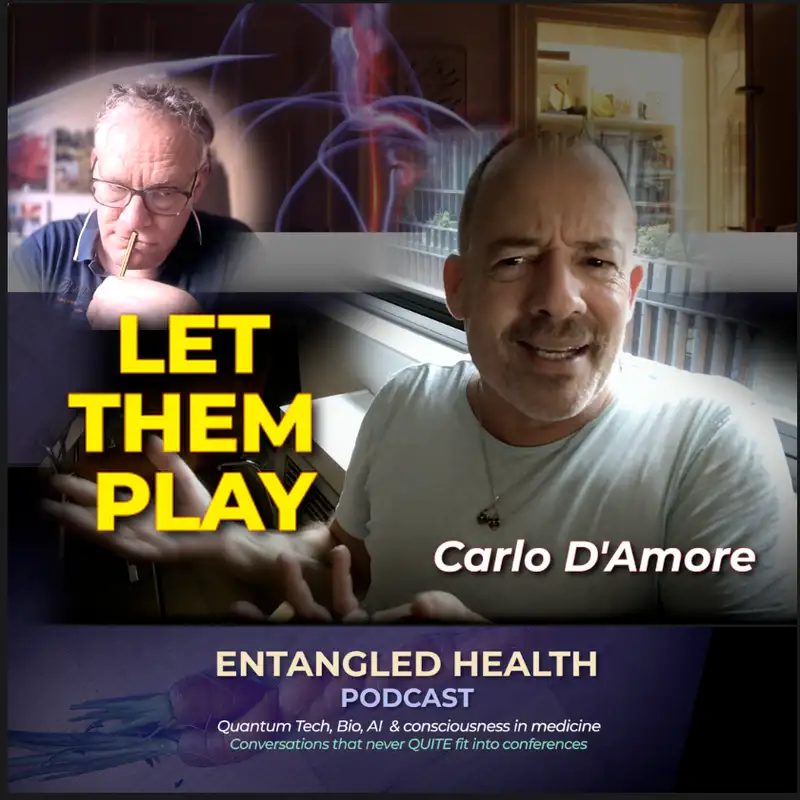
How Immersive Theatre Gets Adults to Play Again | Carlo D’Amore, Live in Theater
At the very beginning of the work, the creators will tell the audience,
don't touch any of the actors, don't talk to any of the actors.
There's a lot of restrictions because I've always jokingly said,
but I'm kind of being serious, that an audience will typically ruin
an interactive performance.
The audience is the first one to ruin it because they're human beings.
Welcome to Entangled Health, where quantum tech, AI, health, biology and consciousness
research overlap.
I'm Thomas Ehmer, and I like to have the conversations that never quite fit into conference or reports.
Hi everybody, my name is Carlo D.Amore, I'm the creative director and founder of LiveInTheatre.
LiveInTheatre.com
We're a theatre company, we're also a gaming company, we're an interactive theatre group,
and we perform true crime.
Yeah, today we're trying something completely different:
treating immersive theatre as a social nervous system.
We want to explore if and how a resonance, coherence, and the observer effect
might shape a room, and we both absolutely don't know where this will land,
so join us on that quest.
and the quick disclaimer these are personal conversations a co-creation between my guest
and me and nothing of this is an official statement from any company or from my employer or anyone
else yeah Carlo D.Amore this is cool and as i said in my intro i have no clue what we're going to
land um i think i think i will just give you the first word and um because you reached out
and yeah what our expectations are and just go
Yeah, well, Thomas, thanks so much for having me on.
I'm excited to talk all things whatever and everything, everything and nothing at all.
I love it.
I love it.
I love it.
I reached out.
Entangled Health, I was really curious as to your podcast.
I listened to some of the episodes, and the thing that really struck me was –
this idea of health being entangled and enmeshed and not one thing, right? Not linear. And like,
I don't know if you've ever had this experience. I'm a jumper. I jump everywhere. So hopefully
you're with me. I can tell. I can tell. I went to a doctor one time. I couldn't tell you what it was
that I had. I had six.
something wrong. And the doctor behind the lab coat, basically, she said, this is what
you, I can't remember exactly what it was, but just let's say I had a strep throat.
And she said, that's not the way you get strep throat. And she was so absolute about
how you don't get whatever the disease was, that in my mind, I thought, okay,
I'm leaving.
This person, you can't be
absolute like that
because I am my own person
and the way sickness
affects me, yes, it's probable
but when you're that definite
credibility
goes out the window.
for me, went out the window for me, and I did leave.
I was sick longer than I probably needed to be.
But nonetheless, so there's something about the title, the name of your podcast, Entangled
Health, that I really leaned into it.
And I'm all about leaning into things that I don't understand.
This is good. So do I. I think we talk about immersive theater and I think we have something here which is, I sometimes mention it on the show, I think this is to bring
people together who should know of each other.
because they bring something to the table
that just the other half never thought of.
And I think the entanglement is, of course,
just braiding or everything hangs together with everything.
So being the physicist myself,
I'm very much into resonance
does it resonate
or do we have
coherence, do we vibe together
do we swing together
and maybe later
in the conversation
when you talk a bit about your experience
what happens when you do these
crime scenes or could we think when we solve such a case, such a crime case?
Yeah.
So maybe you just talk your story about what it is that you're doing.
But is one of these crime cases, could we treat crime as a kind of a disease?
We don't know. We honestly don't know. And if so, could we learn something, how we maybe learn from other cultures, like the Ubuntu people who just don't punish people,
but they just...
they bring people together and talk it out.
They talk it out, for example.
Or if, I don't know.
Yeah, that's a fascinating question.
And let's go down that path.
I think that one of the things that is most interesting to me
me in creating theater because at the end of the day Thomas this these are just stories right it's
all I'm a storyteller like if I had to like break it down to the bare minimum it's I'm a storyteller
and I just happened to started creating uh interactive theater which is the way we define
interactive theater at live in theater is how do we get a non-rehearsed participant
How do we get you, essentially, the audience to co-create the story?
I always do this gesture that you see this gesture that I'm doing.
How do I get you to co-create it with me?
All right.
Yeah.
How do you how do we build it together?
Now, you don't know what the story is.
Right.
So how do I empower you as the audience member to actually build it with me?
OK.
So there's a lot of.
Yeah, you want to say something? You have a question?
No, no, no. I thought these are the people...
So my assumption was, and maybe I'm wrong, I'm definitely wrong.
My assumption was, I buy a ticket and I go to your show and I know we solve, I don't know, case X.
And because it's unsolved, I try to solve it, but that's not the case.
So you rather say, you guys...
No, no, no.
it has many, many, many layers, right?
And one layer is, yes,
essentially you're solving the case.
But this is,
so there's different kinds of immersive theater.
So just a couple of things,
I'll put it out there
just in case some of your listeners
or not familiar with it.
Immersive theater, which is partly what we do,
but we are mostly interactive.
Immersive is literally you're immersed in the world.
So literally you are on stage, you're in a set,
you're like in a movie and you are traveling through the movie.
You're in this world.
That's what immersive at its core means, right?
Interactive is how you are interacting.
A lot of immersive work.
At the very beginning of the work, the creators will tell the audience, don't touch any of the actors, don't talk to any of the actors.
There's a lot of restrictions because I've always jokingly said, but I'm kind of being serious, that an audience will typically ruin an interactive performance.
The audience is the first one to ruin it.
I have a good question on this.
Let's go.
Yeah, go.
Interesting.
Interesting.
Oh, you have a question or should I keep going?
Go on, but let's practice.
Yeah.
At any point, just ask because I'll just keep talking.
But basically, interactive means you are a part of it.
I'm talking to you.
What Thomas says makes a difference to the way I interact with you.
So there are different rules.
most people don't do interactive
and they don't do it to the level that we do it
it's a very high level
and the way we do that is we use
we have little bits of story
that's scripted
and we're improvising around that
very much like this conversation is an improvisation
and we're going back and forth
You know, that is pretty much what we do. In essence, you are there to solve the case. Yes. And the mystery is is ideal for this kind of work because we couldn't really do
Hamlet.
and have it be an effective way to not only do team building,
but also to entertain an audience because it would be too complicated.
So the mystery has to be simple.
In my opinion, art, good art, is at its core simple.
Yes.
Right?
Like if you watch an incredible film, an incredible play,
you can usually tell your friends, oh, this happened and this happened and this happened.
happen. You never go like, "Oh, well, I don't really..." because then it didn't work, right?
The piece of art didn't work, right? So it needs to be simple. And the mystery is simple.
Because in essence, Thomas just needs to solve it.
Yeah, let's just... I have so many thoughts, but let's go for the first route I want to pick up is when you say
it's kind of a team building exercise.
Yeah.
That's what I understood.
So, yeah, which brings me a bit to resonance.
So these people need to vibe together to act as a ensemble to solve the case.
Or if they don't behave, they destroy the game or how does this work?
Yeah.
Yeah, for sure. For sure. So again, thinking of like, okay, it's a mystery. We need the audience to solve it. So we've learned after years and years of doing these how to
like make it as efficient as possible. So we always take the because it's so interactive. We need to break the audience up. Let's say 50 audience members or 100 audience
members, we break them up into small teams.
Because if 100 people are talking to us at the same time, it's very chaotic.
Exactly.
So simple, we make them smaller teams.
Within those teams, we, as the facilitators of the experience, as the creators of the experience, are setting everybody up essentially, hopefully, to win.
And to win means to solve the case.
Right?
it does not mean you're going to it's very difficult they're complicated there's a lot of
layering it's a lot of uh complex narratives that you're trying to follow and to be honest
the shows are very very they're very entertaining people are laughing a lot so on top of everything
trying to understand what happened in the murder how it committed you're also laughing so you're
and and
And we're also allowing the audience, this operates on many different levels.
We're also doing, what we're doing is we're tapping into, as children, we all knew how to play, right?
Right?
So whenever, when you were a child, of course you did.
You're such a scientist.
You're like, I didn't play.
No, but as children, when our adults said, go play.
Almost none of us ever turned and said, "How do we do that?"
Because we knew how to play.
We just knew how to play.
As adults, I think we become atrophy children.
We forget to play because culture, society, you're a man, be a man, don't be silly.
I was in a relationship with somebody that always used to say to me, "Why can't you be serious?"
Bye-bye.
I would always say, "Why?"
Yeah, why?
You know, and that's me, right?
That's my... I'm very... I'm an actor.
We could talk about this for a long time.
I'm an actor and a creator for a reason,
because I have built in me this sensibility of, like, curiosity and imagination,
very much like a child, right?
And I love that.
we're also allowing the audience to play and when they're playing um yeah so how do we we basically
we give you the tools we say okay this is a this is what somewhat it's all one of the main things
that we do is that we play the reality of the situation what do i mean by that if you're my actor i say to you
Thomas, when the audience interrogates you, and that's essentially what the audience is doing.
The audience is listening to the facts of the case, just like if you were a real police officer,
whether you're in Germany or you're in New York City, doesn't matter, right? You get the facts of
the case. What do we know? Right? So everybody gets all of that.
They get the facts.
When the victim was last seen, they get somebody saw something, somebody heard something.
This is evidence.
This is a coroner's report that we have.
This is how the injury was.
So at the beginning, you get all the factual information to be able to start the investigation.
So very much like a real, like if you were a real police officer, right?
Why do we do that?
Because we're all contemporary audiences.
What do I mean by that?
I mean that whatever part of the world you're in, we're all so accustomed to it.
2026 to really high quality storytelling,
great television,
great films.
So we can't do anything.
That's not super authentic.
It needs to feel real.
That's important because that allows the audience to go.
Oh,
wow, this feels very unique.
Because I'm a part of it as the audience,
and it feels like I'm inside a movie.
So that is number one, the realness of it.
Number two, we give you the tools to be able,
very quickly, in character it's called,
the lead facilitator says,
what are questions you're going to ask, Thomas,
to help us solve this case?
So go ahead.
Imagine that I'm asking you that question.
What are questions you would ask of suspects, Tom?
And then I would say, well, where have you been yesterday night?
Yes, exactly. Wonderful. The alibi, right? Alibi. And then we have motive. You know, is there a motive?
What did somebody not like the person? Right. And opportunity. Were you in town in the same place where that person was murdered?
murdered that's it we give you those three things to ask again simple because if we tell you you
have this shakespeare monologue it's impossible right and then your sister's sister was part of
married with this guy i'm out i'm i'm i'm already okay the minute you say but you
but it gets some confusing and then basically that's the first act of the show
The second act, the audience interrogates the suspects.
And we do something else.
So the realness pulls them in, right?
Pulls them in.
They're engaged.
Even if they start off like this, they don't know.
And then I'll gradually see them.
And they start to play. Great. Wonderful. And then we give them pushback. What do I mean by that? The suspects, right, the actors are all directed to come from a place of
this really happened. So they're playing high stakes.
they're playing at the highest stakes
because they're affected by this murder.
So if you, as the audience,
is interrogating me,
and if I believe, as the actor,
we believe, right?
We believe that if you think I'm guilty,
I'm going to go to jail.
My family will be ashamed.
My wife and my kids will.
be without me it'll be a disaster so then i as the actor i'm fighting with you what do you know
thomas how dare you talk to me like that you don't know anything about me so instantly you're like
and then if it happens at work it's even more
because if you and I are best friends and we go do something, it's one thing.
But if you're my boss and I am an intern, there's, oh my God,
I have to behave in a certain way with these actors who are just plain make-believe.
So all of a sudden it takes a little bit of courage to you as the audience to say,
I'm asking the questions here.
Mm-hmm.
All right. So you gain a little bit of confidence.
So we find that we see people connect and bond in ways that they typically do not ever.
Because it's such a novel experience.
Okay.
And this is cool.
I'm just thinking the other point that was on my radar is...
a principle called
uncertainty.
In quantum,
we talk quantum.
You have the uncertainty principle that you can measure
one property very exact and then
the more precise you measure, for example,
in quantum physics, you measure the position.
You don't know the speed
and if you know the speed very much, you just
don't know the place. So that's a good
excuse.
by the way if you get a speeding ticket
uncertainty is an incredible
tool that we
have at our
disposal not just in these
shows but all of us right
uncertain we don't know it's going to
happen.
The audience.
So you said you have these big groups, you're going to split them in smaller teams.
And then are they all solving the same thing or are they part of a bigger team?
No, no, they're all solving the same thing.
So there's a three-act structure.
And the first act is everybody hears the lead facilitator, whoever.
The structure that I'm talking about is the same for all the shows that we have.
But the narratives are very different.
The worlds are very different.
It could be 1800s, 1970s, 1980s.
1960s, today, different worlds, different crimes, different characters, but the structure is the same.
At the top, there's one person.
Everybody hears the facts.
Everybody's taking them down, and then you get sent out.
So you work in one team of 10.
I work in one team.
And then we meet all of the same actors at different times.
So you meet the wife first and then you meet the significant other and then I meet the significant other first and they rotate.
So how we capture the narrative slightly different but essentially the same.
And then this is cool because I was just thinking that there is a terminology which is called tunnel effect.
So the information could tunnel through some barriers.
And I'm now just thinking, if I'm thinking loud, if the actors are interacting with team
one and team two and team three or whatever, it's just needed.
Yeah.
Do they...
leak
information they got
I mean if I'm now playing the role for the
third time I might be influenced by
the first or second interaction because
I had to laugh or they made
a joke and which is framing my picture
or I got aggressive have adrenaline
or whatever is this
yeah
Is this happening?
Or, I mean, the interaction...
That's a great question.
Each actor, each character,
has a certain amount of information
that they have to get out.
and they get it out
and some of them are
pointing directly at
the murderer
and some of them are pointing at
red herrings
and it's entirely up to
the actor has to
00:21:09.880 --> 00:21:11.679
Creators and Guests